HomeLab Tales
2026-05-19
Being a CS student and an active Linux / Unix user, it was obvious that I was going to develop a passion for self-hosting.
My first home-lab was a Raspberry Pi 3B, loaded with an Open Media Vault. At that time, I didn’t know how to use Docker and I was a beginner in Linux systems (being 10 years old). But it was really fun. I accidentally wiped my parent’s hard drive trying to use it as a network drive.
When I started to host (more or less seriously), I was first using my personal « gaming » computer. A desktop, including a i5-4th gen and a GTX 960 with only 2Go of VRAM. This computer was a gift from my parents. After seeing me struggling for years with my franken-puters - built with random outdated components owned from asking people their broken computers - they contributed to this gift. I’ve never been a real gamer and I wasn’t really using this computer for anything except nerd computer stuff. So in 2022, inspired by LTT, I bought my first license of Unraid. I started trying every single Docker container on the hub (hub.docker.com) and it was so fun. This was peak open-source exploring.
Then, two years later, after exploring a lot with this computer, I bought servers with a friend at a government auction. They belonged to the health department and were extremely cheap (100e for 4 of them). I instantly installed Debian on it. It worked, I wasn't lost (daily driving linux for some years now), but I was persuaded that the performance would have been better with a more sophisticated OS (such as TrueNAS or Unraid). I tried both and sticked with Unraid, but it was definitely way too bloated for my needs. I didn’t (and still don’t) have a lot of hard drives to throw in. I wasn’t really planning on building a real NAS full of sensitive personal data but more a computer to host fun projects found on GitHub/Codeberg or self-hosting, with my friends and I, our own websites and services. Unraid is not really appropriate for my use. Back in the days, I was using it mostly because it was mainstream and I was a noob. Now, I feel more confident than I used to be when I first started to host. I don’t need as much GUI. I’m not even using any RAID functionalities, ZSH nor anything fancy… I'm just stuck with a Linux having too many restrictions (being on Slackware and the system being loaded to RAM).
Enough talking about the content, let's get back to the container : my HP Proliant DL385 G7 (great reddit post - not from me, but helped me in the beginning).
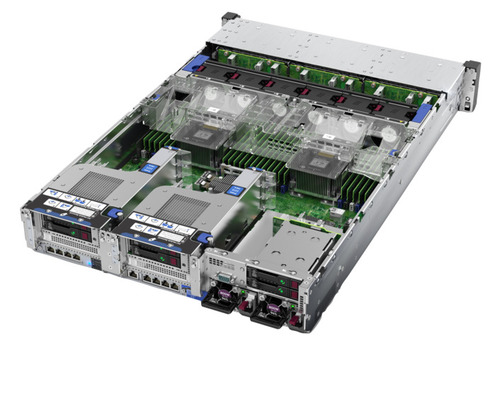
This bad boy moved a lot with me and never really find a comfortable place to sit in. Being an industrial grade hardware, it's not really compatible with any of my accomodation. I tried installing it in my place. Living alone in a one-roomed appartment, it was by far my most noisy housemate.
I tried multiple ideas to reduce the sound of those nuclear turbines. :
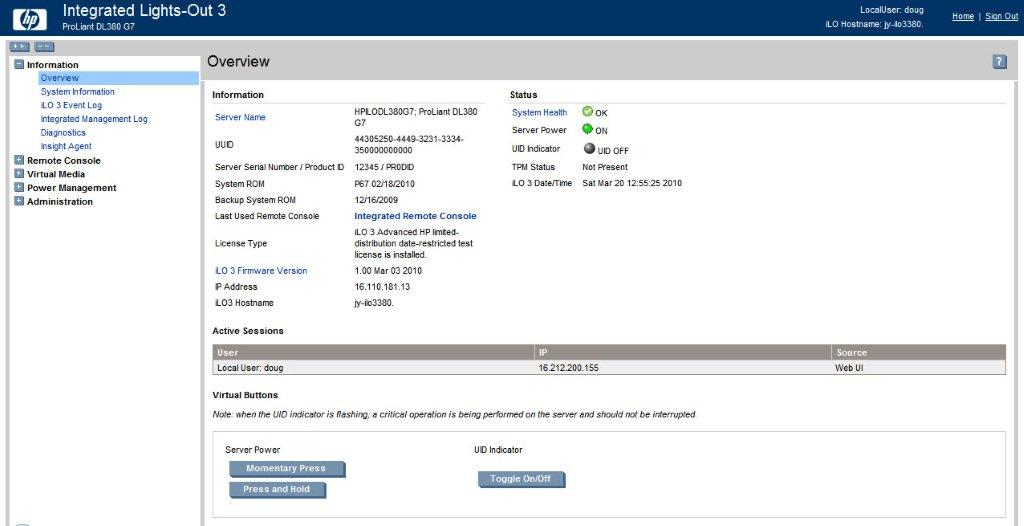
Sound easy right ? Well, it wasn't. I faced lots of different issues during the process but the main one was the ★outdated SSL protocol★. This firmware has not been updated for some years and the webserver it was exposing was quite dusty. Needless to say that trying to print this page on my up-to-date computer with my post-quantuum-cryptography TLS (TLS PQC 1.3) was impossible. I had to tweak every single security settings of my cherished LibreWolf in order to access it. After SOME settings changed, I managed to accept a SSL negociation with TLS 1.1. But I quickly became disillusioned when I saw the lack of control we had on this dashboard. I had no way of controlling the fans. I then found some redditors talking about an alternative firmware that would give more control on the fan speed regulation, but this was limited to the iLo4 compatible servers. In the end, nothing really worked on the software side.
Then, I convinced myself that I was good enough in electronic to change the fans blindely to Noctua ones. And in fact, it almost worked. But I was a bit overwhelmed by classes and I didn't have much free time to work on it. One night, where i needed to extract some data from the not-running server, I quickly connected all the new fans to a USB connector and plugged it into one of the server's USB input. But the resistance of my shitty cable and connections caused a voltage drop under load. The fans were probably getting ~3-4V instead of the 5V they needed. The fans were running sloooowly and were not cooling down the server. It still gave me enough time to extract the data I needed but shortly after, the thermal protection of the server kicked in and switched of the poor guy.
After this, I was a bit depressed. I had no more homelab and no place to try any project. My friend's Matrix instance was down and we switched to Signal. And this was my recent gap with the subject.
I relaunched a HomeAssistant some time after, i don't really remember why. I used a RaspberryPi 4 (4Go) that was given to me by an old employer. I booted it with HAOS and connected the one or two light bulbs and a temp/humidity sensor.
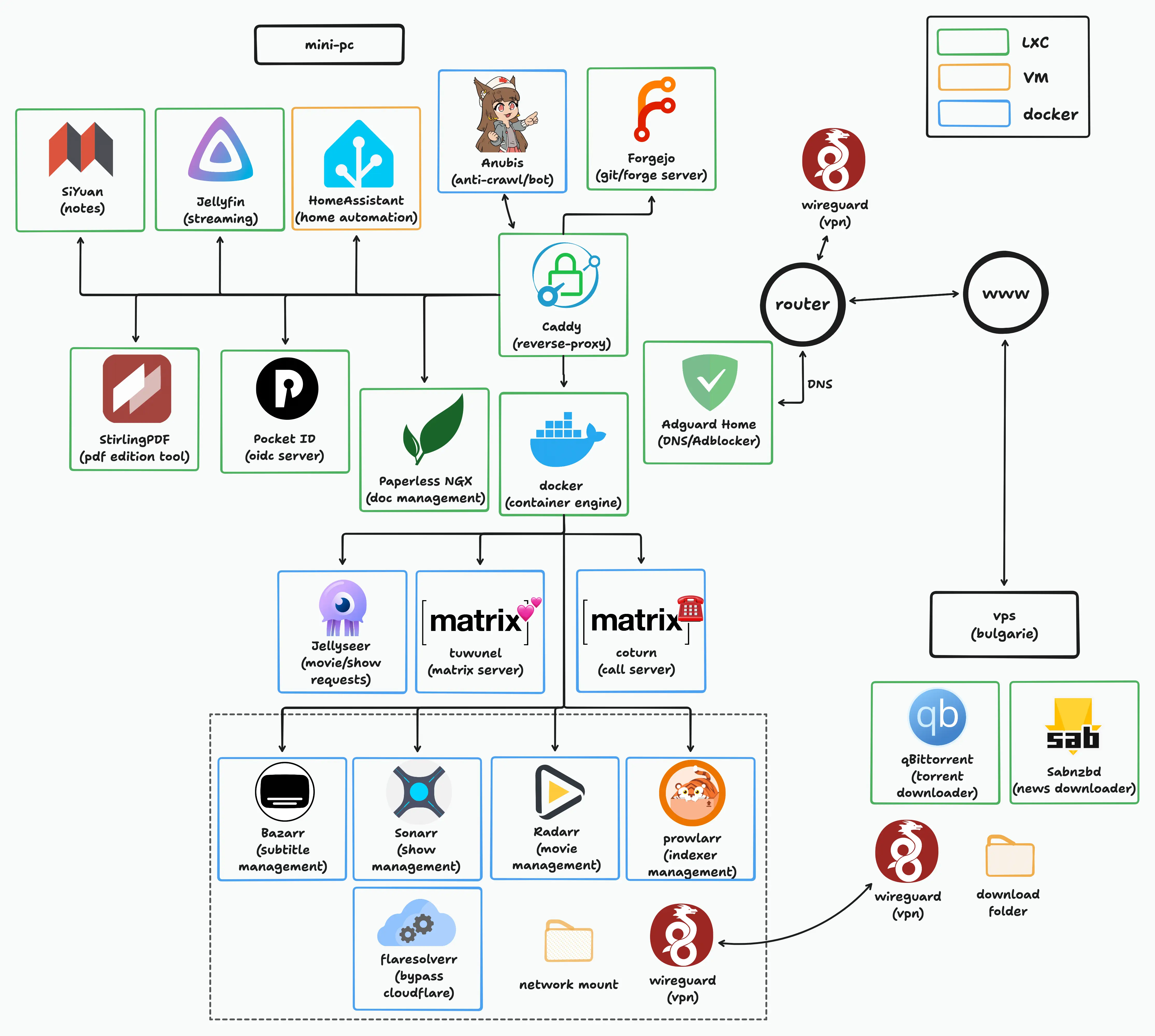
This held for a while but I missed a few other self-hosted services, Matrix, Forgejo, Jellyfin... So I decided to try a more modern architecture, something that will not sound like a plane's engine starting in my flat during summer. I bought a second hand N100 mini-pc (missing reference / image) which would be a nice in-between, even if this option is debatable.
I'm still running this "no-brainer" and it works like a charm. I'm currently hosting on it:
---
All posts